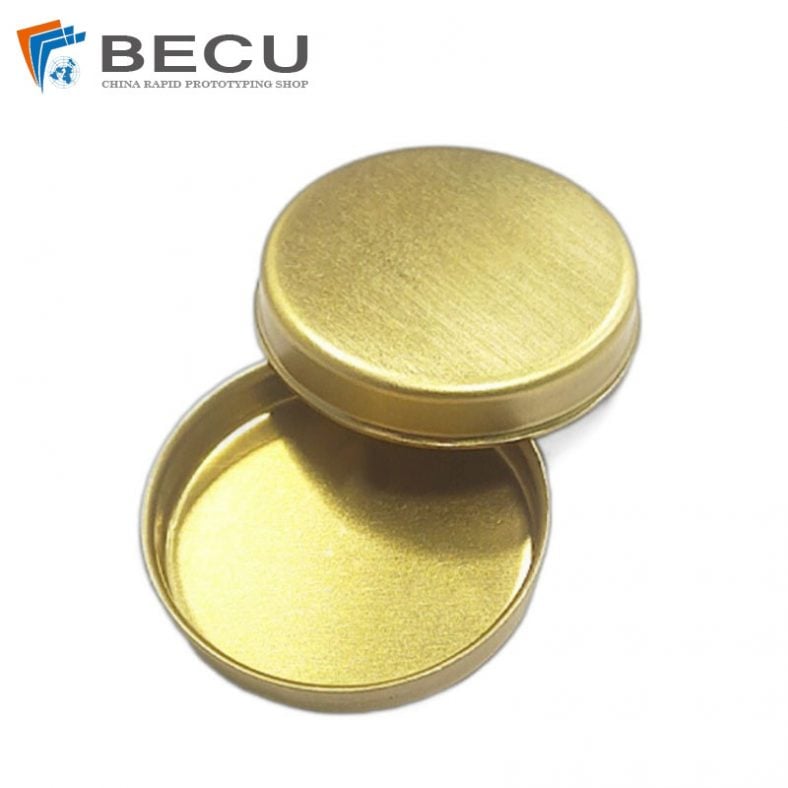

Brass Deep Drawing
Brass is an alloy known for its versatility and superior mechanical and chemical properties. The exact composition of brass can vary, allowing the alloy to be tailored for specific applications. Brass deep drawing stamping is a manufacturing process that combines the inherent properties of brass with advanced metal forming techniques to produce precise, durable, and complex components. Commonly used brass grades for deep drawing include C260 (Cartridge Brass), C272 (Yellow Brass), and C360 (Free-Cutting Brass). These grades are chosen based on their ability to be shaped without cracking or breaking under stress.
Deep drawing is a subset of metal stamping where a flat sheet of material is progressively shaped into a three-dimensional form through the application of mechanical force. Brass, an alloy primarily of copper and zinc, is a popular choice for this process due to its excellent malleability, corrosion resistance, thermal and electrical conductivity, and aesthetic appeal.
Brass Alloys Used in Deep Drawing Stamping
Brass alloys are widely employed in deep drawing stamping due to their excellent malleability, corrosion resistance, and mechanical strength. The choice of brass alloy plays a critical role in determining the success of the deep drawing process, as different compositions exhibit unique properties suited to specific applications. Below is a comprehensive examination of the brass alloys most commonly used in deep drawing stamping, their compositions, properties, and typical applications.
Cartridge Brass (C260)
Copper: ~70%
Zinc: ~30%
Properties:
Excellent malleability and ductility.
High corrosion resistance, particularly in freshwater environments.
Good strength-to-weight ratio.
Exceptional ability to undergo extensive plastic deformation without cracking, making it ideal for deep drawing.
Applications:
Ammunition casings.
Electrical connectors and terminals.
Automotive radiator cores.
Decorative items due to its golden appearance.
Cartridge brass is one of the most popular alloys for deep drawing because it offers a balanced combination of strength, ductility, and corrosion resistance.
Yellow Brass (C272)
Copper: ~63%
Zinc: ~37%
Properties:
Higher zinc content enhances strength compared to C260 but slightly reduces ductility.
Excellent corrosion resistance in most atmospheric conditions.
Good machinability and formability.
Applications:
Plumbing components, such as valves and fittings.
Architectural hardware, including locks and hinges.
Consumer goods, such as musical instruments and jewelry.
Yellow brass is widely used for components requiring a blend of aesthetic appeal and structural strength.
Naval Brass (C464)
Copper: ~60%
Zinc: ~39%
Tin: ~1%
Properties:
Exceptional strength and corrosion resistance, especially in seawater.
Good wear resistance and moderate ductility.
Excellent for components subjected to high mechanical stress and corrosive environments.
Applications:
Propeller shafts and marine hardware.
Industrial valves and pump components.
Heavy-duty fasteners and fittings.
Naval brass is a preferred material in marine and industrial applications due to its combination of strength, wear resistance, and corrosion resistance.
Red Brass (C230)
Copper: ~85%
Zinc: ~15%
Properties:
Superior corrosion resistance, particularly in seawater and industrial environments.
High malleability and excellent workability.
Attractive reddish-gold hue, ideal for decorative applications.
Applications:
Marine hardware and plumbing fixtures.
Electrical connectors in harsh environments.
Decorative plates and badges.
The high copper content in red brass enhances its resistance to corrosion, making it a preferred choice for marine and industrial applications.
Free-Cutting Brass (C360)
Copper: ~60%
Zinc: ~35%
Lead: ~3%
Properties:
Exceptional machinability, rated as one of the easiest alloys to machine.
Moderate corrosion resistance.
High thermal and electrical conductivity.
Lower ductility compared to C260 and C272, requiring precise process control in deep drawing applications.
Applications:
Precision components, such as gears and fittings.
Electrical terminals and connectors.
Decorative items requiring intricate machining.
C360 is not as commonly used in deep drawing as other alloys due to its relatively lower ductility but is utilized when secondary machining operations are required.
Admiralty Brass (C443)
Copper: ~71%
Zinc: ~28%
Tin: ~1%
Properties:
Outstanding corrosion resistance in saltwater and industrial environments.
High resistance to dezincification, which is crucial for long-term reliability in corrosive applications.
Good ductility and formability, suitable for moderate deep drawing operations.
Applications:
Heat exchanger tubes and condenser components.
Marine hardware.
Components exposed to aggressive environments, such as chemical processing equipment.
Admiralty brass is specifically designed for use in corrosive environments, making it a niche choice for applications requiring durability and reliability.
Brass alloys’ adaptability and superior properties make them indispensable in deep drawing stamping. By understanding their unique characteristics and optimizing the manufacturing process, industries can achieve high-quality, reliable, and cost-effective components tailored to diverse applications.
Brass Deep Drawing Stamping – Deep Drawn For Brass Alloy
Brass deep drawing remains a critical manufacturing process across various industries due to its ability to produce complex, high-strength parts with minimal material waste. BE-CU Offering Brass Deep drawing services for tubes, shells, and cans.
ISO 9001:2015 certified. Fabricators of brass deep drawn metal stampings and parts for the industrial, automotive, medical, electronics and appliance markets. Capable of drawing parts from .125 in. to 3.125 in., diameters from .08 in. to 2.5 in. and thickness of .006 in. to .050 in. Finishing services include deburring, polishing, lacquering, painting, slotting, plating and heat treating. In-house tooling with design and engineering assistance available. JIT delivery. Made in the China.
Other stamping methods include coining, continuous, progressive die, fourslide, compound die and punch press. Additional services such as assembly, plating, swaging, trimming and welding provided. Prototype and low to high volume production runs available.

Applications of Brass Deep Drawing Stamping
Brass deep drawing stamping is widely used across various industries:
- Electrical and Electronics: Brass is used in connectors, terminals, and switch components due to its excellent conductivity.
- Plumbing and HVAC: Components such as fittings, valves, and adapters benefit from brass’s corrosion resistance and machinability.
- Automotive: Brass deep-drawn parts are used in radiator cores, fuel system components, and decorative trim.
- Aerospace: The aerospace sector utilizes brass for heat exchangers, fasteners, and other critical components.
- Consumer Goods: Brass is a popular material for decorative items, musical instruments, and hardware due to its aesthetic appeal.
Our Parts Case Studies Gallery Of Brass Deep Drawing Stamping
We perform an efficient, accurate, and cost-effective process in-house to provide superior product results for your Brass deep drawing.Whether you require punching Brass pieces or custom Brass parts, we can easily help you. With our expertise in precision Brass deep drawing and the ability to integrate external combined processes, we can ensure the best performance for your deep drawing Brass projects.